LiveOpen to AI engineer roles — Rome or remote EUDrag · use ← → keys
I build AI systems and the evals that tell me when they're wrong.
Final-year Applied CS & AI at Sapienza University of Rome — GPA 29.2/30, graduating March 2027. Multi-year iOS engineer before that, so the models I train end up inside real apps. Three years teaching IGCSE maths and science: I can explain the hard parts.
Anyone can get a demo working. I measure whether it works.
Every number on this page comes from a harness I can hand you. The most recent run of one: a ground-truth audit that found 3 of 4 apparent retrieval failures were bugs in my eval dataset, not the retriever — killing a planned week of retrieval work before I wrote a line of it.
Eval dataset62 rows
Evals before features
Two-phase harness for course-notes-agent: retrieval scored with zero generation calls, generation scored separately — so "wrong answer" resolves to a cause instead of a shrug. Ground truth anchored to verbatim source text, not chunk ids, so re-ingestion can't silently invalidate it.
Top-1 ranking42 lookup rows
Baselines that embarrass me
I hand-rolled BM25 in ~60 lines to check whether the embedding model earned its keep. It ties text-embedding-3-small at top-1 — 0.76 vs 0.77 — and wins outright on the one query dense retrieval genuinely fails. Deliberately untuned: a baseline adjusted until it loses isn't a baseline.
Out-of-scope questionsrefused
RAG that refuses
PDF → paragraph-aware chunks → Postgres + pgvector → cosine top-k → grounded answer from gpt-5-mini behind a FastAPI /ask. 9 of 9 out-of-scope questions correctly refused, 0 answered with fabricated content.
Test RMSEC-MAPSS FD001
Models behind APIs
LSTM, 1D-CNN and Transformer trained and compared on NASA C-MAPSS; the winner serves live inference at 13.74 test RMSE through FastAPI with per-engine 30-cycle sliding-window buffering. A system, not a notebook.
Monthly blitz volume30 months · ~10⁸ games
Data at ~10⁸ rows
Streaming ETL on AWS EC2: ~100M rated Lichess games, one pass per compressed dump, headers only, resumable. Aggregates into SQLite; analysis in pandas, scikit-learn and statsmodels — validated against 20 + 20 placebo tests, not just p-values.
Deployone command
And it ships
Docker Compose for multi-service stacks, FastAPI inference services, Vercel for the TypeScript tools — plus native iOS in Swift, shipped. Rare enough in AI engineering that it's worth saying out loud.
Eval-first RAG
course-notes-agent — the eval is the project.
A RAG system over my Calculus 2 notes, built eval-first: the retrieval pipeline is deliberately simple, and the most developed part of the repo is the harness that measures it. Two findings came out of it — both from distrusting a number instead of building a feature.
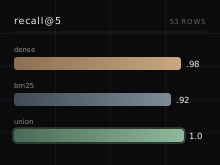
Two charts. The first compares overall retrieval recall at k=1, 3 and 5 before and after a ground-truth audit: recall@1 rises from 0.69 to 0.73, recall@3 from 0.90 to 0.93, and recall@5 from 0.94 to 0.98 — with the retriever unchanged, because every correction was made to the eval dataset rather than the system. The second compares recall@5 over the same 53 in-scope rows: the dense retriever using text-embedding-3-small reaches 0.98 and misses 1 row, an untuned BM25 baseline reaches 0.92 and misses 6, and the union of both reaches 1.00 and misses none.
The ground-truth auditSame retriever · corrected answer keybeforeafterDoes the embedding model earn its keep?recall@5 · 53 rows · full 0–1 axisuntuned baseline
# Deliberately NOT tuned. Textbook k1=1.5, b=0.75, plain \w+.# A baseline adjusted until it loses is not a baseline —# and one adjusted until it wins isn't either.K1 = 1.5# term-frequency saturationB = 0.75# length normalisationdefscore(self, query: str) -> list[tuple[int, float]]:
for term intokenize(query):
f = self.tf[i].get(term, 0)
if not f: continue
norm = 1 - self.b + self.b*self.doc_len[i]/self.avgdl
s += self.idf[term] * (f*(self.k1+1)) / (f + self.k1*norm)
Listing 01The comparison point — ~60 lines, no model, no API call, published in 1994. It ties text-embedding-3-small at top-1
evals/run_eval.pyPython
# WHY GROUND TRUTH IS ANCHORED TO SOURCE TEXT, NOT CHUNK IDS:# chunk ids come from a SERIAL column — re-ingestion renumbers# everything and silently invalidates every row in the dataset.for anchor in row["expected_anchors"]:
matching = {cid for cid, content in chunks if anchor in content}
if not matching:
# A silent zero here looks exactly like a retrieval# failure — and sends you debugging the wrong component.raiseRuntimeError(f"{row['id']}: anchor not found")
requirements.append(matching)
Listing 02Ground truth is software too — an anchor that resolves to zero chunks raises loudly instead of scoring as a miss
Phase 1 and Phase 2 are separate on purpose: a wrong answer has two causes with opposite fixes, and end-to-end measurement reports “wrong” and leaves you guessing. Refusals are split by retrieval coverage, so the generator isn't blamed for retrieval's misses. The refusal judge is blinded — it sees the answer text only, never the question or the expected label, because a judge that can infer the hoped-for answer confirms a hypothesis instead of measuring one. And the headline numbers are optimistic by construction: 28 chunks, questions generated from those chunks, k=5 returning 18% of the corpus. The repo says so, in the README, above the fold.
Real-time ML
Sentinel-IoT — a full ML system, not a notebook.
Three architectures trained and compared on NASA C-MAPSS turbofan data; the winner predicts Remaining Useful Life at 13.74 test RMSE behind a FastAPI service, with a live React dashboard turning those predictions into operational alerts. The model is the small part — the buffering, the alert thresholds and the deployment are the project.
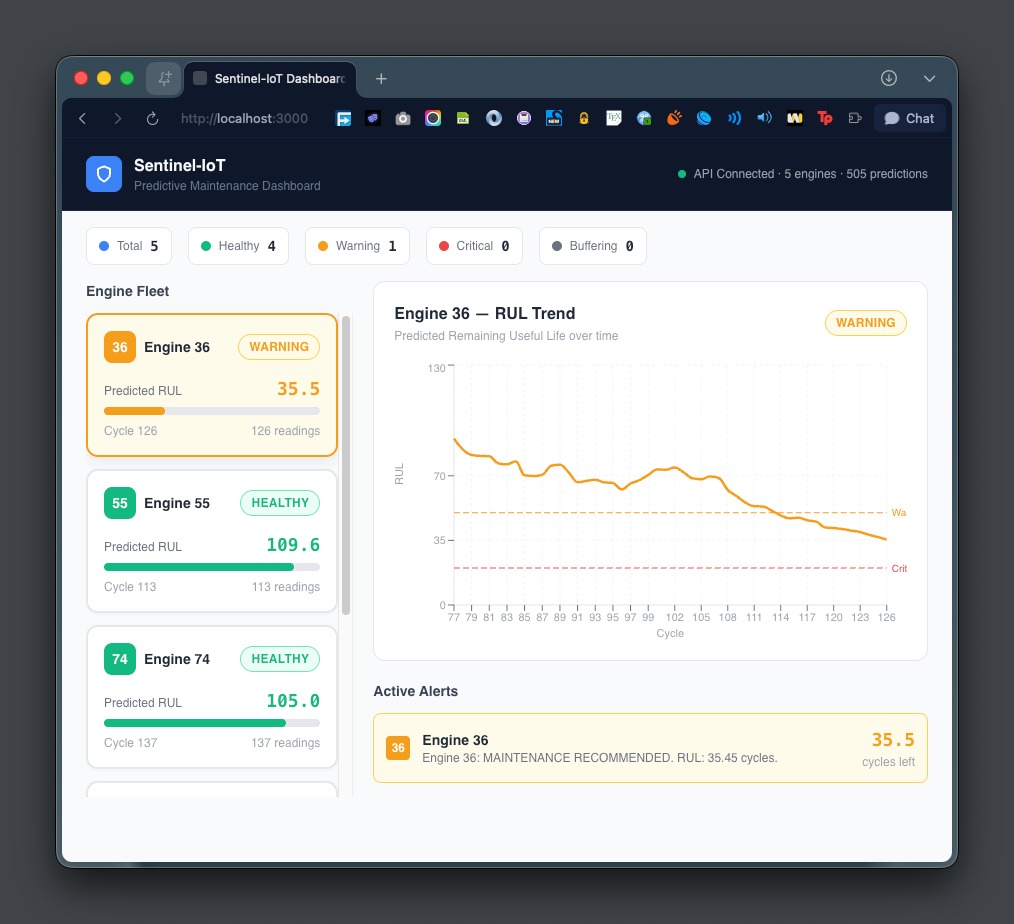
Fig. 01Live demo — fleet cards sorted by urgency, RUL trend charts, alert feed polling every 2s
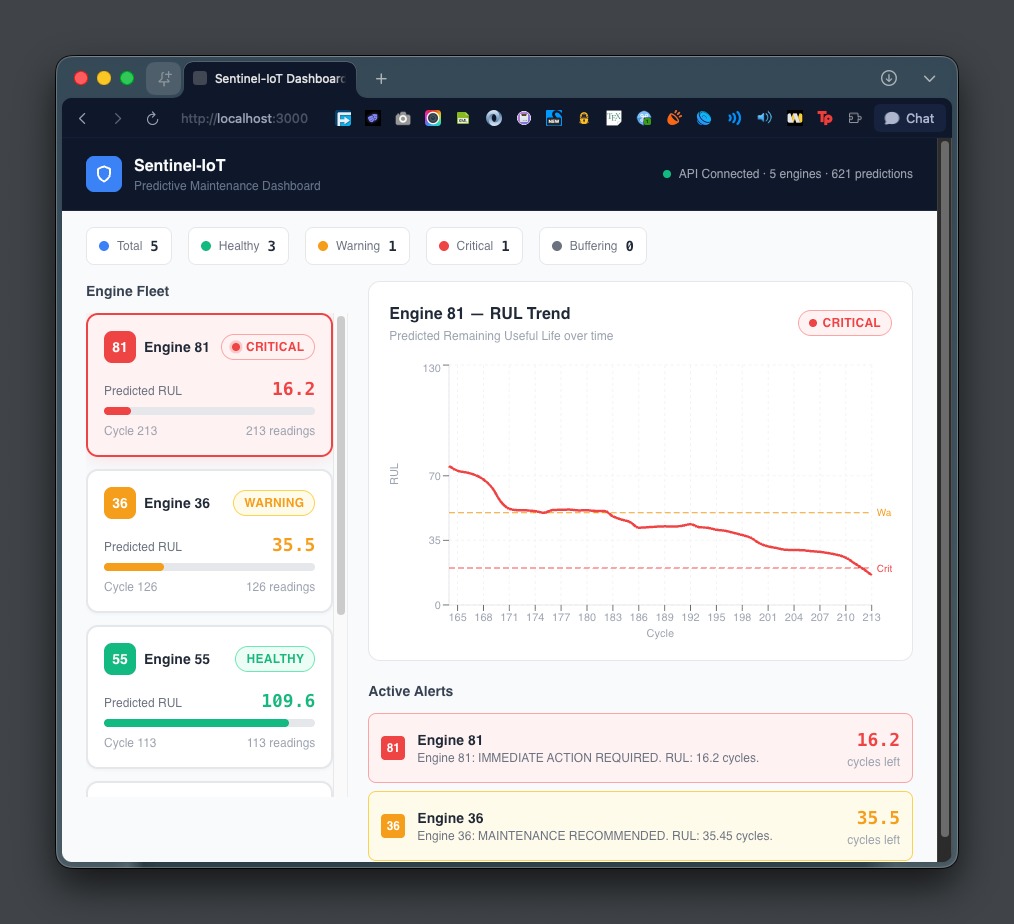
Fig. 03Critical alert — immediate action required, surfaced to the top
Simulatorstreams NASA C-MAPSS sensor cycles, one reading at a timePOST /api/sensor-data
FastAPI backendbuffers a 30-cycle sliding window per engine, runs LSTM inference, owns alert logicGET /api/engines · /api/alerts
React dashboardfleet cards sorted by urgency, RUL trend charts, live alert feedpoll every 2s
dashboard/src/Dashboard.jsxReact
// Fire all three GETs in parallel — concurrent, not sequential.constfetchData = useCallback(async () => {
const [enginesRes, alertsRes, healthRes] = await Promise.all([
fetch(`${API_URL}/api/engines`),
fetch(`${API_URL}/api/alerts`),
fetch(`${API_URL}/api/health`),
]);
/* ... */
}, []);
useEffect(() => {
fetchData();
const interval = setInterval(fetchData, POLL_INTERVAL);
return () => clearInterval(interval); // no leaks
}, [fetchData]);
Listing 03Pull-based by design — simpler than a websocket, proxy-friendly, 2s latency is right for human monitoring
src/api.pyFastAPI
# The API is PASSIVE — it receives; it never fetches.# Simulator, real sensor or unit test all talk to it identically.classSensorReading(BaseModel):
engine_id: int
cycle: int
sensor_values: list[float]
# The API owns the buffer AND the alert thresholds —# "what counts as critical" is a business rule, not a UI concern.WINDOW_SIZE = 30THRESHOLD_WARNING = 50THRESHOLD_CRITICAL = 20
Listing 04Typed contracts via Pydantic — validation + auto-generated Swagger docs at /docs for free
Native iOS
Dibs — I also ship native apps.
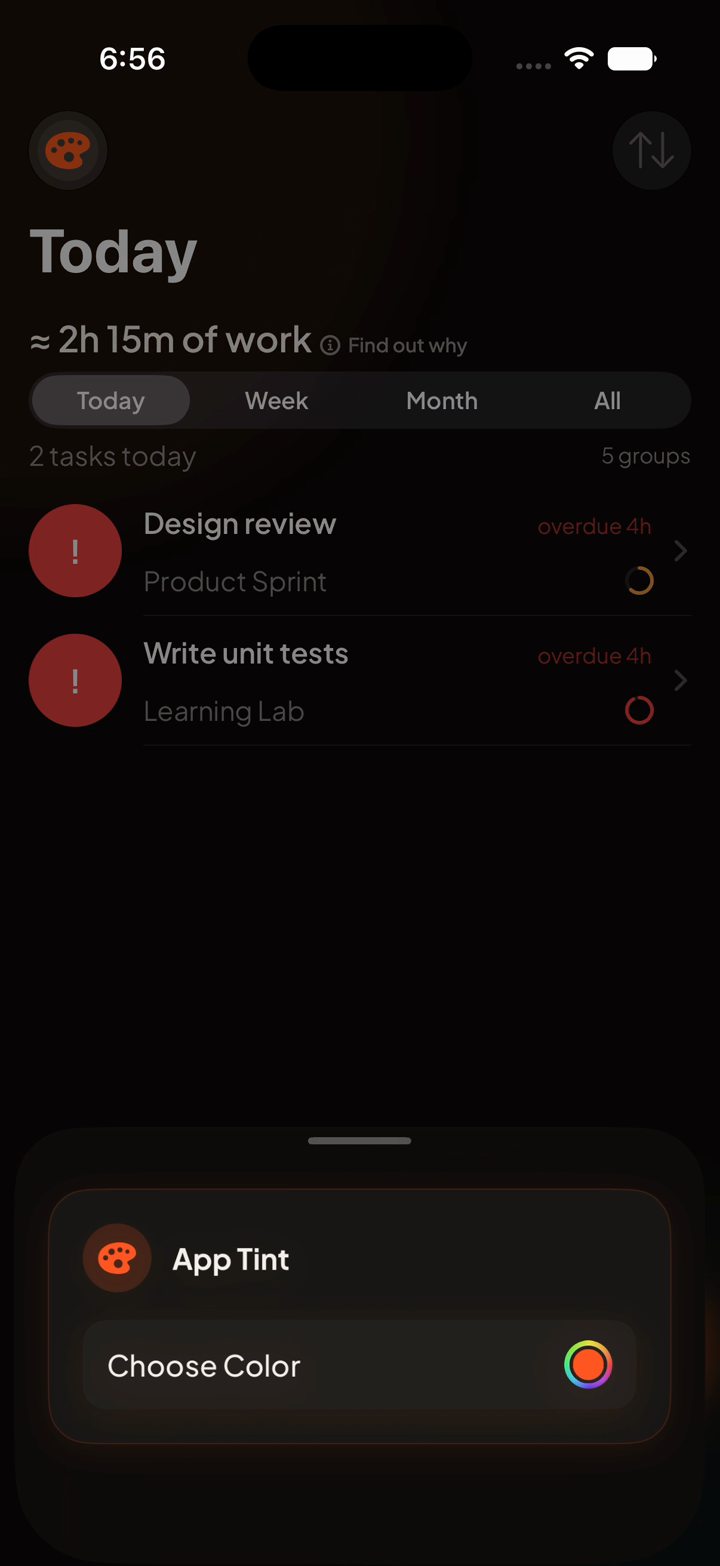
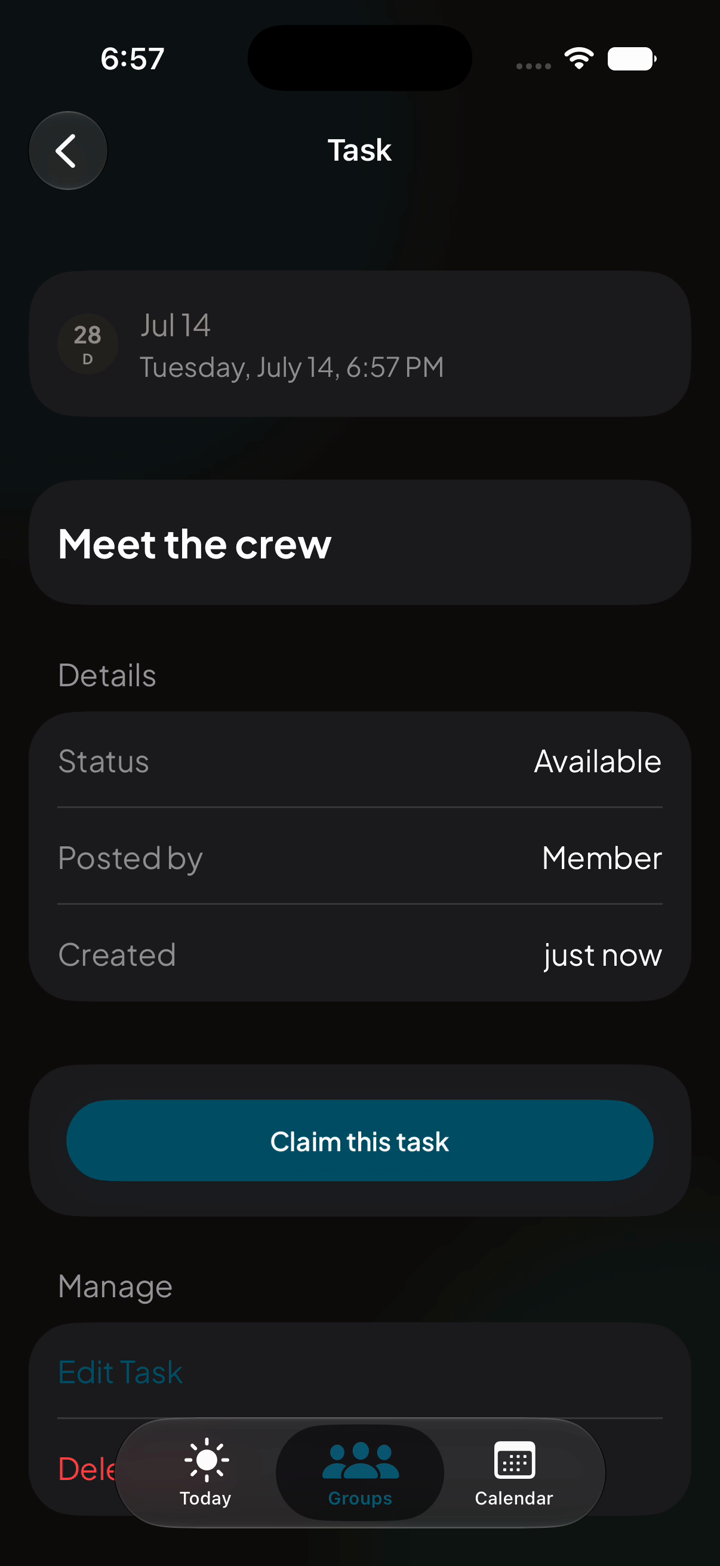
A shared task manager for iOS, designed and built end-to-end in SwiftUI: post a task to a group, someone calls dibs, everyone sees the plan. On top of multi-year freelance iOS work. An AI engineer who can put a model behind a native app instead of handing it over as an endpoint is rare enough to be worth a section.
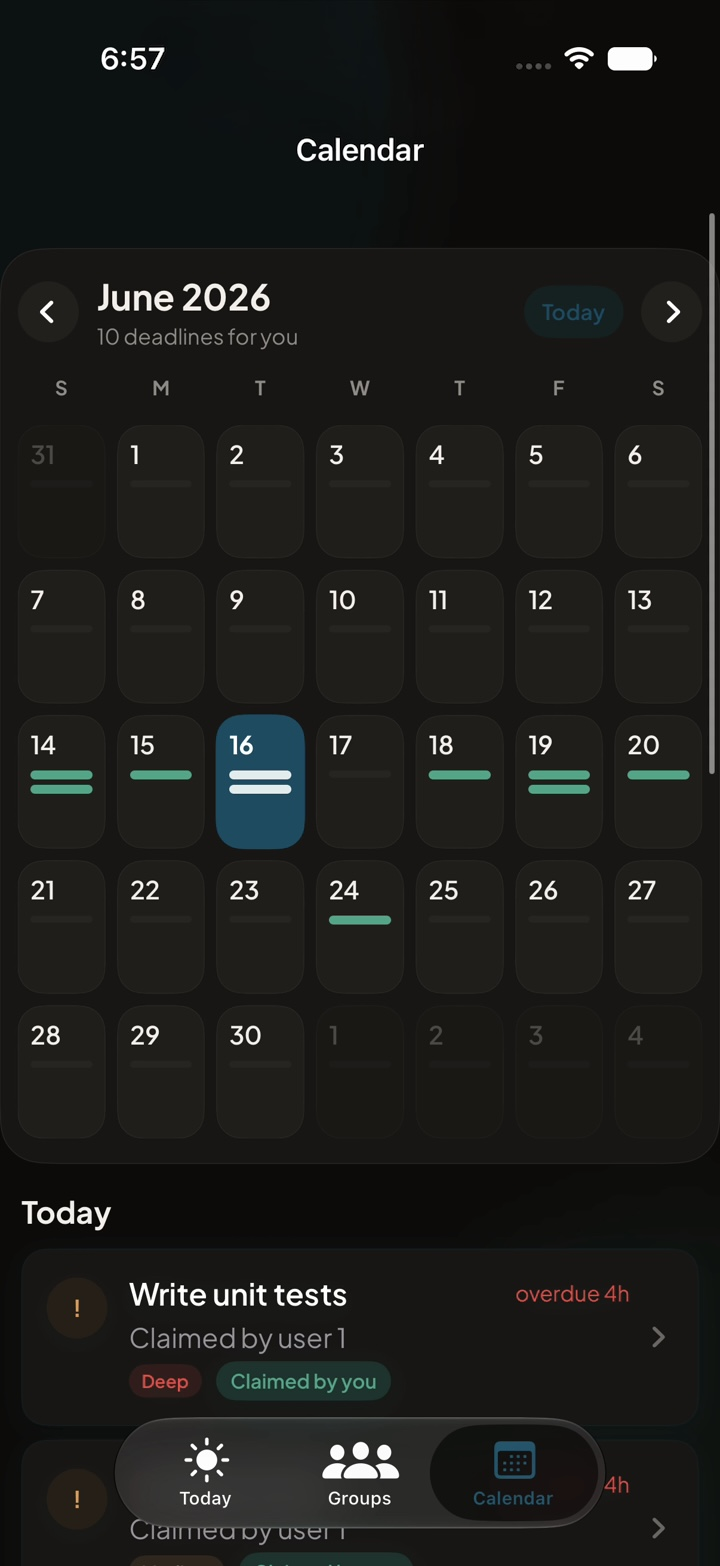
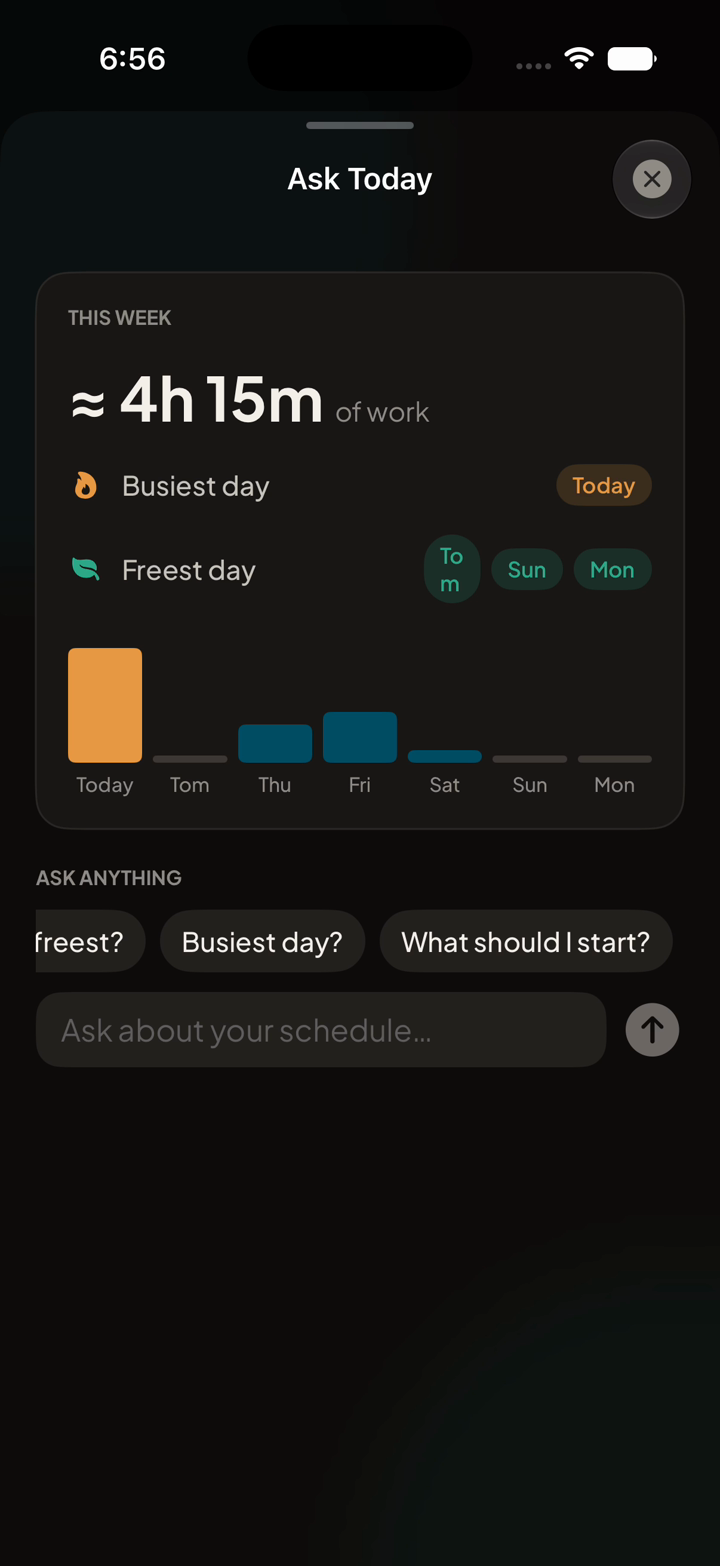
"Ask Today" answers questions about your own schedule — the assistant reads real task data and workload estimates, not a generic chat box bolted onto a sidebar. Shipping that means owning the whole path: prompt, latency budget, and what the UI does while it waits.
ii.
Hierarchy before decoration
Every screen has one job: "Today" leads with the only number that matters — ≈ 2h 15m of work — before any list. Overdue state is colour + copy + position, never colour alone. A full custom colour system underneath, and motion used to explain state changes rather than to show off.
Data engineering
~10⁸ games, one streaming pass.
The data-engineering half of the job: do trap openings spread like viral misinformation? Built on AWS EC2, streaming ~100M rated Lichess games into SQLite one compressed dump at a time, analysed with pandas and scikit-learn — and checked against placebo distributions rather than p-values alone.
About 100 million rated Lichess games were processed across 30 observed months using one streaming pass per file. The monthly all-opening volume chart rises from 15.8 million games in January 2019 to 35.3 million at the July 2020 pandemic and Queen's Gambit shock. A second chart shows exact PCA loadings for trickiness, soundness, punish gap, and surprise; PC1 explains 38.4 percent and PC2 explains 27.1 percent of variance.
Monthly blitz volumeKept Lichess games · all openingsraw counts · millionsFeature loadingsPCA · four z-scored featuresPC1 · 38.4%PC2 · 27.1%
~108rated games parsedLichess monthly dumps
30months analysedresumable EC2 ingestion
1streaming passper file · headers only
20 + 20placebo testsrandom months · control openings
EC2 ingest.pgn.zst dumps
Single passfilter + aggregate
SQLiteviews + rating bins
Analysisregression + PCA
Pandemic play and The Queen's Gambit nearly doubled monthly blitz volume; PCA then compresses trickiness, soundness, punish gap and surprise into interpretable axes. The placebo tests are the point — 20 random months and 20 control openings, so an effect has to beat the null distribution it was measured against, not just a threshold.
More builds
Smaller tools, same care.
01.
WASAText — Vue 3 front to Go back
A WhatsApp-style messenger built end-to-end for Sapienza's Web & Software Architecture course — groups, replies, reactions, read receipts. Designed OpenAPI-first (897-line spec before a line of Go), shipped in Docker. Closed the exam with 30 e lode.
Next.js + TypeScript internal web tool with password-gated flows, attendance, timed duels, score tracking and leaderboards. Deployed on a Vercel-style CD workflow and used weekly in my real classes.
Express REST API with MongoDB/Mongoose persistence, CORS, JSON middleware and request logging, consumed by a React/Vite client with Axios. The bread-and-butter stack of client work, done cleanly.
Internal Python tools that generate, fill, digitally sign and track lesson-report PDFs for my teaching job — replacing a fully manual paperwork workflow for good.
Python · ReportLab · automation05.
Full Stack Open
University of Helsinki's deep-dive into modern web development — React, Redux, Node.js, Express, MongoDB, GraphQL and TypeScript, exercise by exercise.
Software engineering intern at TazarvAfzar Co. — REST API integrations and relational schema design in MS SQL Server, inside a real production environment.
REST · MS SQL Server · production
Method
When a test fails, two things could be broken.
Most people only consider the first one. On my own project the test was wrong three times as often as the system — which is the entire reason I write the harness before the feature.
01.
The test is software too
Four retrieval failures shared a persuasive root cause and justified a week of chunking work. I checked the answer key instead: three of the four were bookkeeping errors in the dataset. recall@5 went 0.94 → 0.98 with the retriever untouched. One real failure is an anecdote, not a pattern.
02.
A number needs a ceiling and an interval
recall@1 can't exceed 0.91 on my dataset — rows needing two chunks max out at 0.5 when k=1 — so quoting 0.73 against a mental baseline of 1.00 measures a structural artifact. Two decimals, deliberately: at n=53 the third would assert precision the sample size doesn't support.
03.
Credentials
30 e lode in Deep Learning and in AI Lab: Computer Vision & NLP at Sapienza. Stanford Machine Learning Specialization (Coursera). 3rd place, Sharif University CS Summer School national competition.
Education
The grades behind the projects.
Final year of Applied CS & AI at Sapienza, graduating March 2027.
ENEnglish — fluent, IELTS 8.0 FAPersian — native ITBased in Rome since 2023
Course
Year
Result
Web & Software Architecture
2026
30 e lode
Programming I
2024
30 e lode
Programming II
2024
30 e lode
Deep Learning
2026
30 e lode
AI Lab: Computer Vision & NLP
2025
30 e lode
Human–Computer Interaction
2026
30 / 30
Probability
2025
30 / 30
"30 e lode" = 30 with distinction, the highest possible grade in the Italian system. Full transcript available on request.
How I work
Hire the trajectory, not just the snapshot.
I'm early in my career and honest about it — what I offer is speed of learning, ownership, and work whose numbers you can check.
i.
I learn whatever the product needs
PyTorch for one project, pgvector for another, SwiftUI, Go, EC2 — none of these were handed to me in a lecture. This field reshapes itself every few months; if your stack moves to a different model, framework or serving path next quarter, I'll meet it there.
ii.
Responsible & independent
I've balanced a full-time degree with a real teaching job since 2023 — deadlines, classrooms, paperwork. When I say something will be done, it gets done, without needing a push.
iii.
Decisions written down, with revisit conditions
Open any file in my repos — the reasoning is next to the code, including what I rejected and what would make me change my mind. decisions.md in course-notes-agent logs every call and the condition that reopens it. Nobody should have to reverse-engineer why a threshold is 30.
iv.
I can explain the hard parts
Three years teaching IGCSE maths and science — if you can get a room of teenagers through a proof, you can get a product manager through why recall@1 has a ceiling. I take feedback without ego and give it with care. Persian, English, and enough Italian to laugh at the right moments.